

This article was featured in the official IMPA publication - Supply Chain and Sustainability Magazine, Issue 5 2025
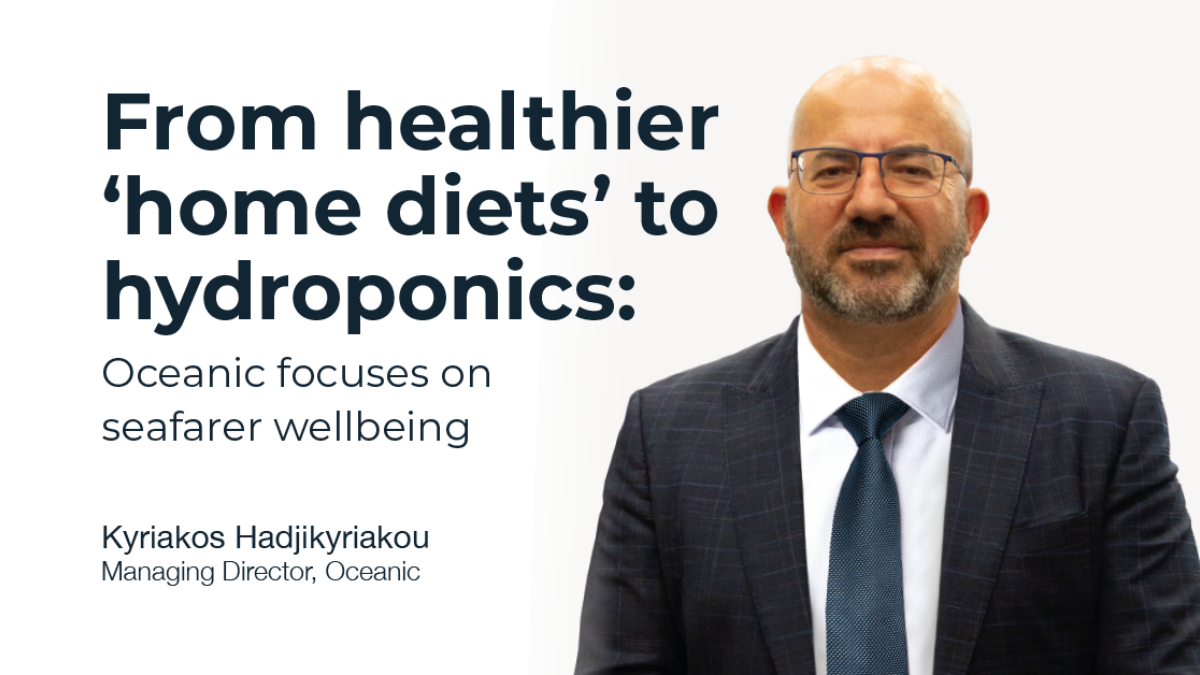
Oceanic has expanded rapidly since it was set up back in 2002. Of equal importance, says Managing Director Kyriakos Hadjikyriakou – the company has evolved as customer demands have changed. He spoke to Felicity Landon.
Maritime catering and hospitality specialist Oceanic continues to grow its customer base – today it provides catering and wellbeing services to about 2,500 vessels in all sectors of the industry, looking after about 50,000 seafarers in all. Managing Director Kyriakos Hadjikyriakou says this reflects the company’s excellent track record – many existing clients have been with Oceanic for more than ten years – and strong brand recognition.
“Also, it’s the fact that we listen to our clients, whose demands change all the time,” he says. “There are new expectations. When we started, it was more about the supply of provisions, making sure there was enough quantity and variety. Now, customers expect that you are there close to the seafarer, that you value their wellbeing, that you provide an excellent working environment on the vessel to support seafarers, improving their quality of life. If we achieve this, we support our clients’ efforts to retain their crew, which is very important when there is a shortage of young people who wish to go into shipping. There are many other opportunities open to young people – shipping is in direct competition with other industries, so we need to make sure that we meet the expectations of young seafarers, and that they are treated as we would expect to be treated shoreside.”
As the largest catering provider for the merchant fleet, Oceanic leverages its global procurement power to ensure best quality and service for its managed fleet. “But we are also very local,” Kyriakos emphasises. “We have a global footprint with presence in many of the key seafaring countries. We are visible, supporting, educating and helping galley and catering crew in the Philippines, India, China, Myanmar, Indonesia and Sri Lanka. The fact that we are investing so much of our effort in educating, training and upskilling our catering crew is a key area in gaining the trust of our principals.”
There is much discussion around seafarer wellness and wellbeing and even an ongoing debate about exactly what that means. Seafarers long for their ‘home diet’ and naturally want to eat the foods they enjoy when onshore, says Kyriakos. “But that is a challenge sometimes, if that food is not so healthy. It’s about changing the mindset and moving to more healthy eating habits. When you are ashore, even if you eat fatty foods, you still have the opportunity to exercise, walk, go to the gym and manage your time as you wish. But on board, you’re in a confined environment for up to nine months, without those same choices. There might be a small gym but if you regularly eat unhealthy food, it will inevitably affect your health over time.”
We have a global footprint with presence in many of the key seafaring countries. We are visible, supporting, educating and helping galley and catering crew in the Philippines, India, China, Myanmar, Indonesia and Sri Lanka. The fact that we are investing so much of our effort in educating, training and upskilling our catering crew is a key area in gaining the trust of our principals.
Oceanic trains its cooks to adopt healthier recipes and cooking methods, including vegetarian and vegan cooking, says Kyriakos. It delivers hand-on training but, as not all cooks are able to travel to the training centres, there is also a blend of online training, e-learning modules and onboard training and mentoring, often provided by Oceanic’s catering superintendents who visit vessels. “But a lot more is about gaining their attention and earning their trust, so they know that we are there to help them, to solve issues, to guide them and to be there for them. This is the journey we are on.
“The trend with the younger generation is microlearning and we are trying to be as focused as possible. Whether in written training or demonstrations, everything is short and to the point, because we recognise that life on board is busy and even for training our cooks don’t have the luxury of being able to stop.”
By employing a team of its own chefs across many nationalities, Oceanic has access to a broad knowledge of national cuisines and preferences. This knowledge is combined with the expertise of nutritionists in Cyprus, Manila and Mumbai.
“As well as providing material and reviewing menus, we attend crew conferences and talk about the importance of a balanced diet and finding ways to take favourite dishes and make them healthier,” says Kyriakos.
NERIS, Oceanic’s software system, enables cooks to look at recipes, create menus and order supplies, record daily usage and produce monthly reports. “While we create menus to assist the onboard cooks, these are only recommendations based on nationalities, preferences and nutritional elements – they will improvise and change as they wish. No menu is set in stone. We are not in a position to tell anybody what they must eat!”.
Solutions include creating a forum for cooks across a specific fleet so they can discuss and exchange ideas and seek advice and motivation from Oceanic’s in-house chefs and trainers. This is particularly important now that assistant cooks have become a rarity, leaving cooks coping with a busy schedule, perhaps with some help from a messman or steward if they are lucky. “Cooks are in an isolated position but if there’s a fleet of 50 vessels and you get 50 cooks talking and exchanging ideas and two or three trainers joining the discussions, this gives them the opportunity to move away from the isolation, to socialise and talk about the daily activities. From getting up to prepare breakfast, through to the last meal of the day, along with taking deliveries of provisions, keeping storage areas clean and tidy, keeping track of the inventory – quality, quantity and expiry dates – and providing reports to the office, the cook is one of the busiest and most important people on board. What they do affects everybody.”
Oceanic employs about 280 people, including 250 in operations and about 30 providing training. “We want to grow with our traditional line and service offerings, but we are also open to any opportunities that come up where we feel we can provide support through our leverage,”
says Kyriakos.
A recently added initiative, ‘Hygiene as a Service’, moves ships away from often harsh chemicals traditionally used on board, providing chemical-free cleaning solutions for galleys and accommodation. Oceanic has also introduced onboard ‘gardens’, where crew can grow leafy vegetables and herbs. This won’t provide a full supply of fresh products, Kyriakos explains, but it could meet the requirements for perhaps a week out of every month. “Also, this is an activity that helps with mental health, as crew have to take care of the plants. We have considered a number of solutions for many interested clients.”
Many of our suppliers have been with us for years. When they deliver to our vessels, they represent Oceanic. And if an issue arises,
they will do everything possible to resolve it.
Geopolitics continue to have an impact on operations. “We are part of a group that is very sanctions compliant. We must be very vigilant when it comes to any partners or clients trading in sanctioned areas,” says Kyriakos.
An internal mechanism flags up any instances of a client trading in sanctioned areas: “We immediately stop the service with those clients – it is the right thing to do. For any new client, we go through KYC and nothing is registered in our system unless we have clearance from our compliance department. There are frequent changes and the situation is fluid – we need to navigate this, and it is extremely challenging.”
Suppliers are subject to the same checks. There is also an added and increasing focus on sustainability to consider. As well as planning for new emissions regulations, Oceanic has focused on removing plastic water bottles by replacing them with water filtration units, switching away from plastic food containers or packaging to glass and tin, and encouraging vessels to offload recyclable waste through its supplier network.
Kyriakos says he doesn’t believe in changing suppliers frequently: “You can’t build true partnerships that way. Many of our suppliers have been with us for years. When they deliver to our vessels, they represent Oceanic. And if an issue arises, they will do everything possible to resolve it. Ultimately, it’s about how we succeed together.”
Equally, the focus is on creating partnerships with clients, moving away from the transactional relationships of the past, he says. “It took a lot of hard work for clients to trust us, and we must always strive to maintain this trust. They give us a very important element of their business, trusting us to take care of their seafarers, their food and their wellbeing. It is a trust we highly value and always wish to reinforce.”
.............................................................................................................................................................................
Read more articles like this: here
Read more articles from the IMPA BLOG | Subscribe to receive a digital copy of the IMPA Magazine

