This article was featured in the official IMPA publication - Supply Chain and Sustainability Magazine, Issue 5 2025
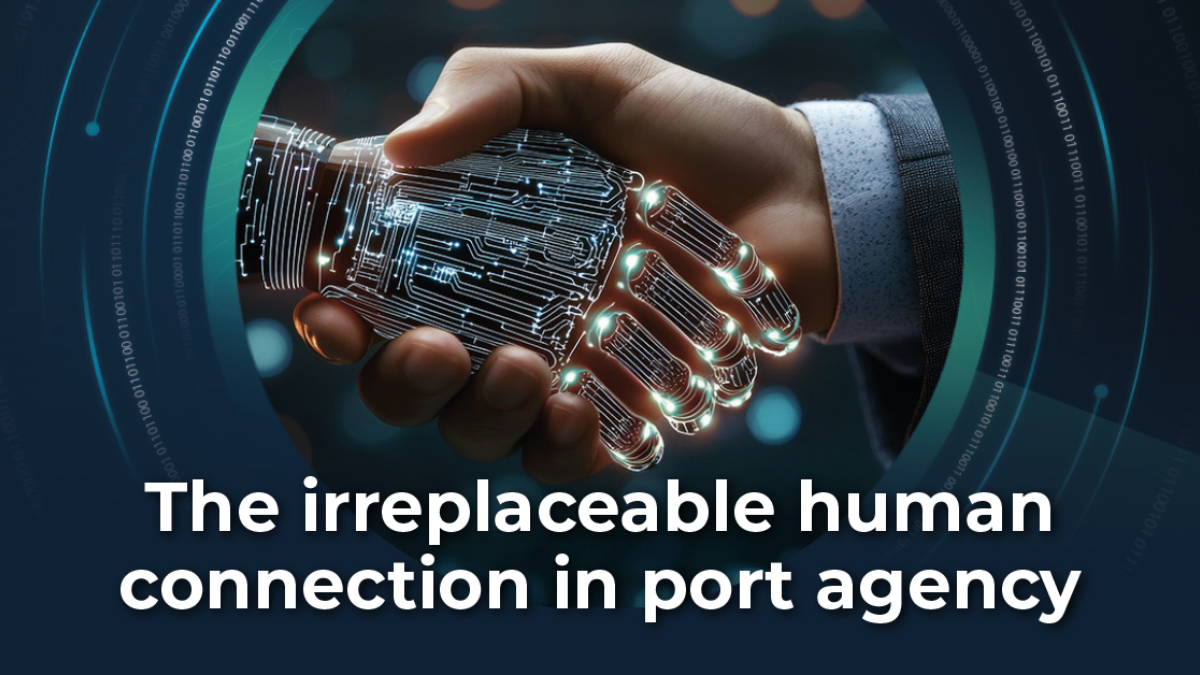
In an era of rapid technological advancement, artificial intelligence (AI) is making significant progress across various industries. However, in the complex and nuanced field of port agency, human relationships are not only valuable but essential. While AI can enhance communication, streamline processes, and provide data-driven insights, it is crucial to consider how these technologies interact with the personal connections vital to our industry.
The current landscape
A 2024 report commissioned by Lloyd's Register indicates the growing influence of AI in the maritime industry. According to the report, the maritime AI market is estimated at $4.13 billion, with an expected Compound Annual Growth Rate (CAGR) of 23% over the next five years.
The recent survey "The State of AI: How Organisations Are Rewiring to Capture Value," conducted by McKinsey & Company, found that 67% of respondents reported increased revenue from their supply chain management in the second half of 2024. Additionally, 63% noted growth in their service operations, with significant cost reductions across business units.
Yet, beneath these impressive numbers lies a more complex narrative about the role of technology in an industry founded on trust, personal networks, and human expertise.
The technological promise and potential
AI offers numerous exciting opportunities for shipping companies aiming to improve the management of port calls and husbandry services. By utilising advanced automation technologies, AI can enhance decision-making, boost operational efficiency, and significantly reduce workflow challenges.
AI can support numerous areas in managing port and husbandry calls:
- Vessel & Route Management uses predictive analytics to forecast arrival times and optimise voyage planning by analysing shipping data, weather, and traffic patterns.
- Contract & Financial Operations streamlines DA processes through automated calculations, contract analysis, invoice processing, and claims management using digital tools and historical data comparisons.
- Vendor & Risk Management ensures regulatory compliance and proactive risk identification while automating procurement processes and providing
real-time negotiation insights.
- Husbandry Management coordinates vessel supplies, crew logistics, and maintenance through intelligent resource allocation and automated procurement systems.
- Communication Management enables round-the-clock communication through chatbots, intelligent routing, and real-time translation capabilities.
- Analytics provides comprehensive operational insights through data analytics, financial modelling, and sustainability tracking for ports and shipping operations.
AI offers numerous exciting opportunities for shipping companies aiming to improve the management of port calls and husbandry services. By utilising advanced automation technologies, AI can enhance decision-making, boost operational efficiency, and significantly reduce workflow challenges.

Is the sky truly the limit for AI?
AI can potentially transform port call and husbandry management significantly, but this process is not seamless or free of challenges. First, it requires substantial initial investment, strong data infrastructure and skilled personnel who can interpret and manage AI-driven systems Additionally, there are concerns about data quality and privacy, cybersecurity risks, and the possible displacement of traditional roles within the maritime workforce, losing human expertise and institutional knowledge.
According to Deloitte's recent "2024 Year-End Generative AI Report," 78% of respondents expect to increase their overall AI spending in the next fiscal year. However, barriers remain, with 38% of respondents mentioning compliance with regulations, 32% citing challenges in managing risks, and 27% facing implementation issues.
McKinsey & Company's survey identifies the main AI-related risks organisations are working to mitigate: data inaccuracy for 45% of respondents, cybersecurity concerns for 40%, intellectual property infringement for 35%, and regulatory compliance issues for 30%.
Considerations for the maritime industry
While AI promises transformative potential for the shipping industry, it simultaneously introduces a complex landscape of risks that organisations must carefully navigate. The technology's limitations become increasingly apparent when confronting the nuanced realities of maritime operations, where human expertise and contextual understanding have traditionally been paramount.
AI systems may struggle with unexpected scenarios, demonstrating a limited ability to make sophisticated, context-specific decisions that require deep institutional knowledge and human judgment. The technological vulnerabilities extend beyond operational challenges, encompassing strategic and legal dimensions, including potential miscalculations when AI attempts to anticipate unpredictable factors such as geopolitical disruptions, sudden market shifts, or extreme weather events.
Perhaps most critically, the human element remains irreplaceable. AI's current limitations in understanding complex emotional and empathetic contexts mean that critical decisions might be made without the nuanced human perspective that has long been essential in maritime operations.
The irreplaceable human touch in port agency operations
Port agency is fundamentally built on relationships, with decades of personal connections and trust that technology cannot replicate. Experienced agents maintain vital relationships with authorities, vendors, and officials based on mutual understanding and trust. Their cultural intelligence and personal networks enable creative problem-solving beyond standardised approaches, especially when facing unexpected challenges.
Maritime operations require emotional intelligence and hands-on experience to navigate complex human interactions and high-stakes decisions. During emergencies or logistical challenges, human agents can interpret subtle cues, mediate effectively, and negotiate with empathy. Understanding the human context behind shipping challenges requires genuine insight that technology cannot provide.
Furthermore, port calls involve numerous tasks requiring significant physical exertion, specialised skills, and coordination between vessel crew and shore personnel—from throwing and catching mooring lines to securing vessels, deploying gangways, and positioning fenders.
While AI excels at data processing, port agencies require adaptive, context-sensitive problem-solving that addresses the unique challenges of each port, vessel, and cargo. Human agents apply their expertise and historical knowledge to inform decisions, making judgment calls based on a comprehensive understanding rather than isolated data points.
Technology can support operations, but it cannot replace fundamental human elements like building genuine trust, navigating complex cultural dynamics or carrying out physical tasks inherent to port calls. The maritime world's unpredictability requires adaptive human intelligence to interpret nuanced situations appropriately and make things happen.
While AI excels at data processing, port agencies require adaptive, context-sensitive problem-solving that addresses the unique challenges of each port, vessel, and cargo. Human agents apply their expertise and historical knowledge to inform decisions, making judgment calls based on a comprehensive understanding rather than isolated data points.
Conclusion: a collaborative future
The future of port agencies lies in the harmonious synergy between human expertise and artificial intelligence. AI systems excel at managing extensive data, streamlining repetitive procedures, and generating analytical insights. At the same time, human agents remain essential for cultivating relationships, applying emotional intelligence, navigating complex challenges adaptively, and physically executing the practical aspects of port calls.
Rather than substituting human relationships, the true potential emerges when AI augments these connections with enhanced intelligence and efficiency, transforming shipping professionals into more strategic, responsive, and value-added partners.
When choosing maritime solutions, businesses should prioritise partners who possess genuine hands-on understanding, the ability to build strong relationships, and empathy. These qualities enable partners to exceed expectations and deliver exceptional results when challenges arise.
The Inchcape approach: provide our customers with the best of both worlds
At Inchcape, we believe the future lies not in replacing human relationships but in augmenting them. AI should be a powerful tool that enables our professionals to be more strategic, responsive, and value-added in their interactions.
Our commitment remains unchanged: delivering human-driven relationships powered by intelligent insights. As the maritime industry continues to evolve, Inchcape stands at the forefront, embracing technological advancements while preserving the core of what makes our industry exceptional—human connections, trust, and personalised service.
The future of shipping is not AI versus humans. It's AI and humans working together.
.............................................................................................................................................................................
Sources:
“Beyond the horizon, Opportunities and Obstacles in the Maritime AI Boom”, various authors, Thetius IQ commissioned by Lloyd's Register, 2024.
“2024 year-end Generative AI report”, various authors, Deloitte, 2024.
“The State of AI: How Organizations Are Rewiring to Capture Value”, various authors, McKinsey & Company, 2024.
.............................................................................................................................................................................
Read more articles like this: here
Read more articles from the IMPA BLOG | Subscribe to receive a digital copy of the IMPA Magazine