This article was featured in the official IMPA publication - Supply Chain and Sustainability Magazine, Issue 4 2025
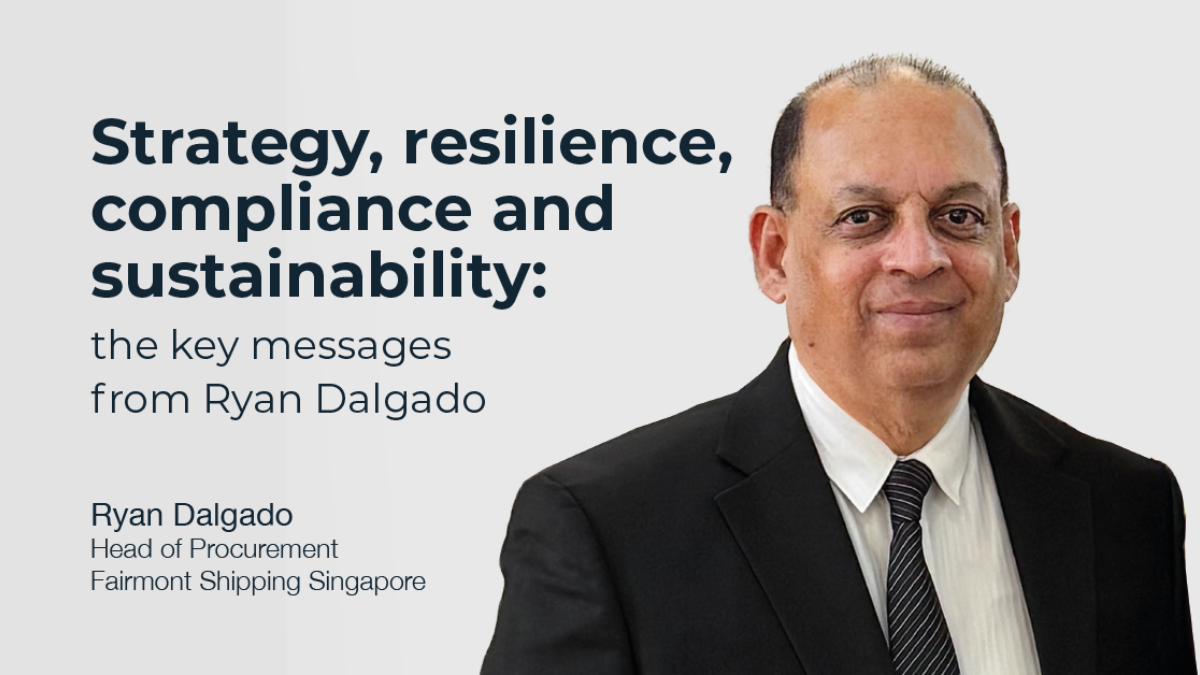
The maritime supply chain is one of the most challenging and difficult of any industry, says Ryan Dalgado, Head of Procurement at Fairmont Shipping Singapore. He spoke to Felicity Landon about strategy, commitment and how his seagoing background has helped to inform his approach.
Rewarding, satisfying and intense – all words used by Ryan Dalgado to describe the maritime industry and the privilege of pursuing a career within it. “No two days are the same; every day brings new challenges; I would strongly recommend young people to come into the maritime procurement field,” he says. “It provides opportunities to interact with internal and external stakeholders worldwide, so they can develop a lot of confidence and multiple skills in doing their job.
“There are a lot of experts in procurement in areas such as the public sector, construction, banking and general industry, but only a few specialised in maritime”.
With his seagoing experience, depth and breadth of experience and appropriate high-level qualifications, he says his profile ‘ticks all the boxes’ and he is now keen to pass on his knowledge through future teaching and mentoring opportunities.
Ryan started his career as a seafarer, sailing for several years on deepsea vessels trading worldwide. “It is a significant advantage, having first-hand experience in the use of many of the goods and services we buy and also of the unique shipboard environment,” he says. “Life at sea is quite different to life ashore so after several years at
sea, I came to a point in my career when I had to decide – either stay at sea or come ashore and try a new challenge. I decided to go into ship management.”
This was a turning point. Since then, Ryan has worked in ship management for leading ship owners and ship managers worldwide, holding responsibility for the entire spectrum of shipboard requirements for supplies and
services, across the globe. He has also worked in corporate categories, including in the travel and hotel sectors.
Already qualified with an HND in marine electronics from South Tyneside Marine College, when he came ashore Ryan gained an NVQ in supply chain management, a master’s in procurement from the University of South Wales and full membership of the Chartered Institute of Procurement and Supply.
“Maritime procurement is a very niche area of the whole procurement spectrum, as a lot of the goods and services we buy are unique to this industry and also our supply chain is probably one of the most complex and difficult to manage, quite simply because our delivery point is moving, often randomly,” he says. “It is very challenging to plan deliveries and keep operating costs within budget.”
What has he learned, and what is he keen to pass on?
“In recent years, my objective has been to transform procurement from a transactional function to a strategic role, adding value to the business. High on my list of objectives is to mitigate risk and ensure business continuity. Not so long ago, Covid-19 brought huge disruption to our supply chain. Manufacturers were short of raw materials and subcomponents, and we found it very difficult to get equipment and spares. Flights were very limited so we couldn’t fly spare parts and service engineers around. If we did get them to their destination, ports themselves were very restricted to where they could go on board.
Maritime procurement is a very niche area of the whole procurement spectrum, as a lot of the goods and services we buy are unique to this industry and also our supply chain is probably one of the most complex and difficult to manage.
“More recently, we have faced several disruptive situations – tariffs, geopolitical tensions and escalating costs. We must quickly come up with ways to mitigate these situations.”
These experiences have taught the industry valuable lessons about mitigating risk and resilience, says Ryan. In less fraught times, he says a key and ongoing priority is to optimise internal processes. “The maritime industry is far behind other industries in terms of digitalisation and efficient processes. I try to achieve ‘more with less’ – more efficiency and output with fewer steps and less effort.”
The company’s procurement processes are entirely paperless and traceable end to end, from the request raised by the ship coming into the system through obtaining quotations, approval of quotations, placing orders, delivery to ship and invoicing.
Ryan would like to see the industry introduce more automation, particularly for repetitive orders or requests.
“I estimate 60-70% of vessels’ requests are repetitive, so I do not see why every requisition needs to go through the same process. The system should recognise any repetitive requests and be trained to handle them through a structured and automated process,” he says. Initiatives to achieve this are ongoing.
He believes in rationalising the supplier base to the minimum possible, eliminating tail spend and then applying the Pareto concept of 80% spend with 20% of the suppliers. “The top 20% are our tier one suppliers which we segment on the Kraljic Matrix and then manage appropriately depending on which quadrant of the matrix they are positioned in,” he says.
There are periodic onsite audits. “We visit suppliers’ facilities, where a comprehensive check is carried out in
areas such as their procedures, certifications, products, stock and compliance with the UN Global Compact. We
have a feedback loop on quality, service, etc., for all supplies and services to our ships. We need to hear from the ships’ staff about any supplies or services received which did not meet the required standards or were deficient in any way. All this feedback is kept on record and discussed with suppliers at their periodic performance reviews.”
Some other key initiatives Ryan has implemented to secure better value include: aggregating volumes across business units to achieve more competitive pricing and better commercial terms – “You often see business units in companies working in isolation and each doesn’t take notice of what others are doing,” says Ryan; and implementing category management and formal programmes of supplier performance and relationship management – “Maintaining close relationships with suppliers enables us to look after the vessel better.”
Ryan has identified several ‘key ports’ around the world for taking on supplies. “These are major ports where you can get most requirements – lubricants, paints, chemicals, general stores and provisions – and the pricing is competitive as there are multiple suppliers in competition. To keep our operating costs as low as possible, whenever our vessels call at a key port, we usually take a full stem of all requirements.”
Sustainability is an important requirement. “We all have a responsibility to ensure sustainable practices are embedded into our operations so that we preserve the planet for future generations,” says Ryan. “That means having minimal environmental impact throughout our supply chain. We require our approved suppliers to hold the ISO14000 certification, which is an indication that they have robust environmental management standards.” Sustainability initiatives have included reducing the use of single-use plastics to a minimum – for example, by installing water filtration systems on vessels and providing metal flasks to those on board; all cleaning products supplied being eco-friendly; requiring suppliers to take back plastic shrink wrapping and pallets; changing onboard lighting to LED; and organising deliveries to the vessel by drone where possible.
The job is very rewarding and satisfying as, at the end of the day, we are ensuring that the ships’ staff are working in a safe environment and well looked after, and that the vessels are well maintained, compliant with all regulations and always available to meet their commercial commitments.
Above all, Ryan thinks of the seafarer. “Living conditions must be good; they need to be well fed with food
preferences considered, have connectivity available on board and be repatriated home on time. These are issues
we take seriously.”
Ryan previously served on the IMPA Council, until work commitments and distance took over. “IMPA plays an important part in the industry, acting as a bridge between buyers and sellers and ensuring we all work closely together for the common good of the industry,” he says. “IMPA exhibitions are excellent events where buyers and suppliers can come together in an informal setting, discuss business and improve relationships. I am convinced, at least in the maritime sector, that a lot of business is done based on personal relationships.”
Effective maritime procurement practitioners must have a clear understanding of the responsibilities and importance of their role, Ryan concludes. “They need to be willing to multitask and to work in an intense, fast-paced and pressurised environment. It is important that they are aware and are willing to be called out outside office hours, as that is the 24/7/365 nature of the business. However, the job is very rewarding and satisfying as, at the end of the day, we are ensuring that the ships’ staff are working in a safe environment and well looked after, and that the vessels are well maintained, compliant with all regulations and always available to meet their commercial commitments.
...........................................................................................................................................................................
Read more articles like this: here
Coming soon interviews with Tse Hai Ng, General Manager, Marine Supply Chain for Kuok Maritime Group and Henning Wegner, Head of Procurement at Oldendorff Carriers
Read more articles from the IMPA BLOG | Subscribe to receive a digital copy of the IMPA Magazine