This article was featured in the official IMPA publication - Supply Chain and Sustainability Magazine, Issue 5 2025
When a ship closes the final blue mile to her berth, the last thing any master or crew wants is a delay caused by poor-quality or defective equipment. Yet for maritime pilots, encountering such issues is all too common — and in many cases, a delay is the lesser of two evils when the alternative is the failure of a piece of ship’s equipment such as a pilot ladder.
Under SOLAS Chapter V, Regulation 23, pilot ladders now have a maximum service life of 30 months, or three years after the date of manufacture (whichever comes first), with stricter requirements on inspection and record-keeping. Each ladder must be supplied with a certificate confirming its date of manufacture. Unfortunately, when purchasing from suppliers without verified certification, it remains possible to receive substandard ladders accompanied by falsified documentation.
This is not a trivial concern. Ensuring that a ladder is purchased through reputable suppliers and to the correct standard can prevent serious incidents — protecting not only pilots’ lives but also the reputation and operational efficiency of the ship, her owners, and agents. A compliant ladder is more than a safety item; it’s a demonstration of a ship’s overall safety culture.
If a pilot or crew member identifies a non-compliant transfer arrangement, they are required to report it to the master and appropriate port authority, and refuse its use until it is corrected, in line with SOLAS V/23. What might appear to be a small cost-saving measure can easily result in a costly delay and unwanted scrutiny.
A compliant ladder is more than a safety item — it’s a reflection of a ship’s safety culture.
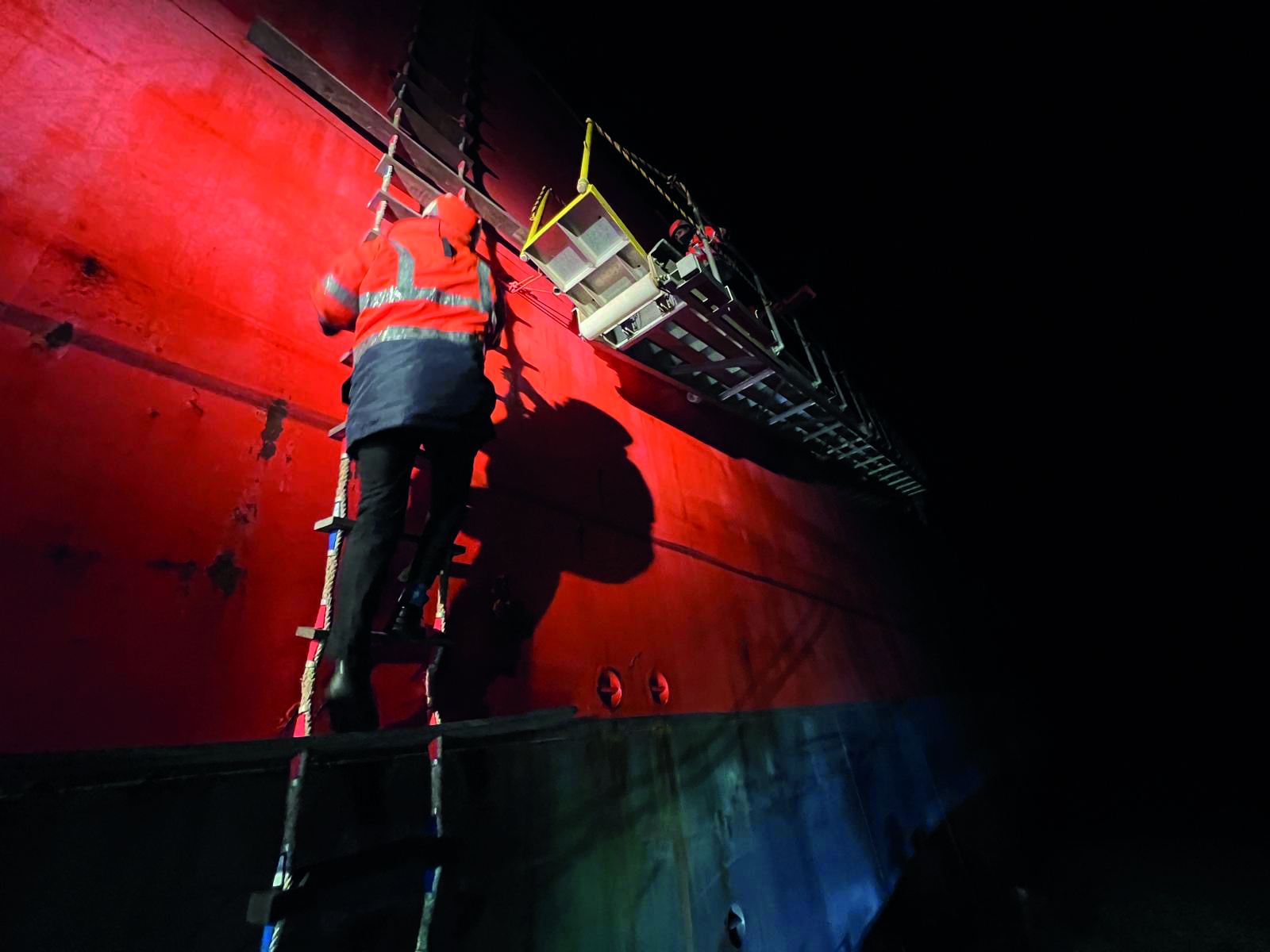
However, purchasing a compliant ladder is only the first step — the real challenge lies in ensuring it’s rigged correctly, every single time.
For pilots, the most frequent issue remains poorly rigged ladders — even when the ladder itself is compliant, a lack of knowledge, supervision or bypassing guidelines can lead to the same outcome.
Recognising this persistent problem, and in light of recent updates to international standards, the UK Maritime Pilots’ Association (UKMPA), www.ukmpa.org, has produced an interactive pilot ladder poster. Designed for today’s seafarers, it provides clear, visual guidance on how to correctly rig a pilot ladder. The resource can be accessed via the QR code on this page and is intended to make compliance easier to understand and achieve.
The UKMPA strongly encourages early adoption of these enhanced standards across the industry. The safe and proper rigging of pilot ladders is not a bureaucratic exercise — it reflects good seamanship, professional respect, and a commitment to safeguarding lives.
New installations must comply with these new regulations from January 1, 2028.
– Existing installations on SOLAS ships must be brought up to standard no later than their first survey after January 1, 2029.
– Non-SOLAS ships must comply starting January 1, 2030.
Because when a pilot steps aboard, every transfer should be safe, seamless, and worthy of the same trust the crew place in the pilot navigating that final blue mile.