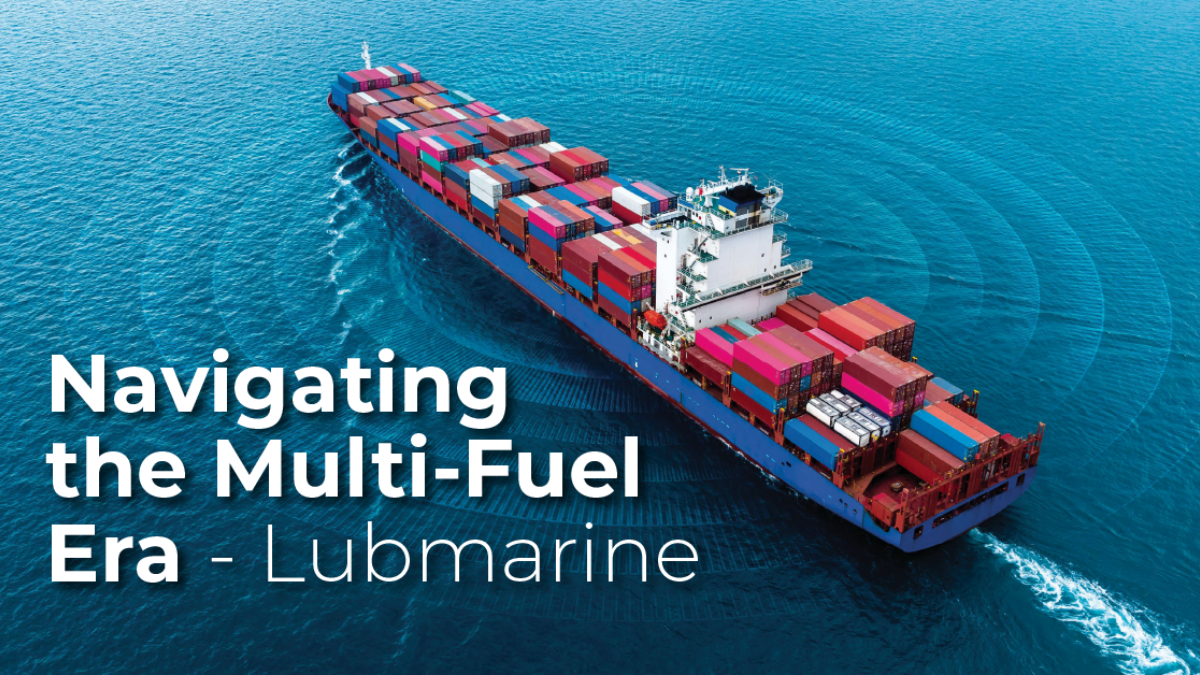
"Navigating the Multi-Fuel Era"
How Lubmarine’s comprehensive range of products, and digital services are powering the industry’s transition to a multi-fuel future.
***
Navigating the Multi-Fuel Era: How Lubmarine Is Enabling Smarter Lubrication Strategies for a Changing Industry
The maritime industry has entered one of the most complex fuel transition periods in its history. The path to decarbonisation is no longer a single channel – it’s a multi-channel maritime highway of fuel choices, each with its own operational implications. From LNG to biofuels, methanol and ammonia, shipowners are faced with unprecedented technical and commercial decisions. In this evolving landscape, the role of marine lubricants and the services that support them is critical.
At Lubmarine, the marine lubricant business of TotalEnergies Lubrifiants, versatility has become a defining feature of our range. Shipowners are no longer looking for a single product for a single engine type – they’re looking for adaptive solutions that can perform reliably across varied and changing fuel profiles, and optimized engines designs. Our portfolio has been engineered to bridge this complexity, giving operators the flexibility to transition between fuels without compromising engine protection, efficiency, or compliance.
For example, our future multi-fuel-ready engine oil ranges are developed with advanced additive technology to manage the different acidities, combustion characteristics, and deposit tendencies of future fuels. Whether a vessel is running on conventional VLSFO in one voyage and a biofuel blend the next, our products are formulated to keep engines clean, protected, and operating at peak efficiency. This versatility reduces the operational friction and cost of switching fuels, a key advantage as fleets adapt to market conditions, charterer requirements, and tightening IMO emission targets.
Adapting R&D for the Fuels of Tomorrow
The International Maritime Organization’s greenhouse gas reduction strategy is accelerating the push towards alternative fuels. Meeting these targets requires not only new fuel technologies but also lubricant innovation to match.
Our R&D teams are fully engaged in developing and validating lubricant formulations for a range of low - and zero-carbon fuels. To address the challenges head-on, they conduct extensive in-house laboratory, rig, and sea trials in collaboration with engine OEMs to ensure formulations are proven in real-world conditions before market release.
Collaboration as a Force Multiplier
In such a fast-moving environment, lubricant development cannot happen in isolation. Our close partnerships with engine OEMs, shipowners, and operators are central to how we shape both our product range and our service offering.
OEM collaboration ensures that our lubricants are optimised for the latest engine designs and compliant with manufacturer specifications. It also means we’re involved early in the conversation when new engine technologies are being tested, allowing us to anticipate lubrication needs before those engines enter in service.
With shipowners and operators, the dialogue is equally important. We work directly with fleets to understand their operational realities by vessel type and needs, from mixed-fuel bunkering schedules to maintenance constraints. These insights feed directly into our technical service development, ensuring that our onboard and onshore tools are aligned with how vessels actually operate – not just how theory suggests they should.
Turning Data into Decisive Action
One of the most important shifts in this multi-fuel era is the role of digitalisation in lubrication management. When switching to new fuels, operators can no longer rely solely on past operational experience – the variables are too different, and the margin for error is too small. This makes continuous monitoring and rapid feedback essential.
One of the most important shifts in this multi-fuel era is the role of digitalisation in lubrication management. When switching to new fuels, operators can no longer rely solely on past operational experience – the variables are too different, and the margin for error is too small. This makes continuous monitoring and rapid feedback essential.
(images copyrighted to Lubmarine)
Our digital services platform is designed to empower both onboard crews and onshore technical teams with timely, actionable information. Take our LubInsight onboard kits, for example. These allow engineers to analyse oil samples directly on the vessel, detecting early signs of lubricant degradation or abnormal wear. The results are transmitted instantly to shore, where superintendents and technical teams can compare performance across vessels, issue proactive alerts, and recommend adjustments to avoid damage.
When multiple samples are collected and fed into our LubDiag Engine Monitoring program, our marine lubricant engineers can detect patterns across the fleet. This enables targeted recommendations – such as adjusting feed rates or operational parameters – to optimise engine performance under the specific influence of the new fuel in use.
Condition-Based Maintenance in Practice
Feedback from operators is clear: condition-based maintenance (CBM) is the preferred strategy for managing the uncertainty of fuel transitions. Lubmarine’s response is a fully integrated, data-driven ecosystem that transforms maintenance from reactive to strategic.
At the centre is MyLubmarine Monitor, our unified platform that consolidates onboard analysis, used oil reports and lubrication charts into a single dashboard. Whether you’re a chief engineer at sea or a fleet superintendent ashore, you can visualise trends, benchmark vessel performance, and plan interventions before minor issues become costly failures.
Importantly, we don’t let the data speak alone. Every automated insight is reviewed by our marine engineers, who bring field experience to validate trends and recommend practical actions. Digital tools can process and visualise vast amounts of information, but it’s the combination of analytics with human expertise that drives meaningful reliability improvements.
Training, Support, and a Human Touch
Technology is only as effective as the people who use it. That’s why we complement our digital platforms with training and on-site engineering services. Crews are trained not only to operate the diagnostic equipment but also to interpret results in context – understanding what a change in iron content means under methanol combustion, or how ammonia might affect lubricant alkalinity.
This capability building ensures that condition-based maintenance isn’t just a corporate aspiration but a day-to-day operational reality. And when an unexpected pattern does appear, our field engineers are ready to step in, whether remotely or on board, to troubleshoot and recommend corrective actions.
Future-Ready Support for a Multi-Fuel World
As the industry accelerates towards decarbonisation, there’s no single “future fuel” winner – at least not yet. Shipowners will navigate a complex mix of transitional and destination fuels for years to come, with regional availability, cost, and regulation all influencing choices.
Lubmarine’s role is to simplify that complexity. We do this by delivering or developing lubricants that can perform across a spectrum of fuels, by investing in R&D for the fuels of tomorrow, and by pairing our technical expertise with advanced digital monitoring to turn operational data into confident decision-making.
It’s a future that demands both versatility and precision. With our integrated approach – products, services, and partnerships – we’re helping shipowners and operators not just adapt to the multi-fuel era but thrive in it.