This article was featured in the official IMPA publication - Supply Chain and Sustainability Magazine, Issue 2 2024
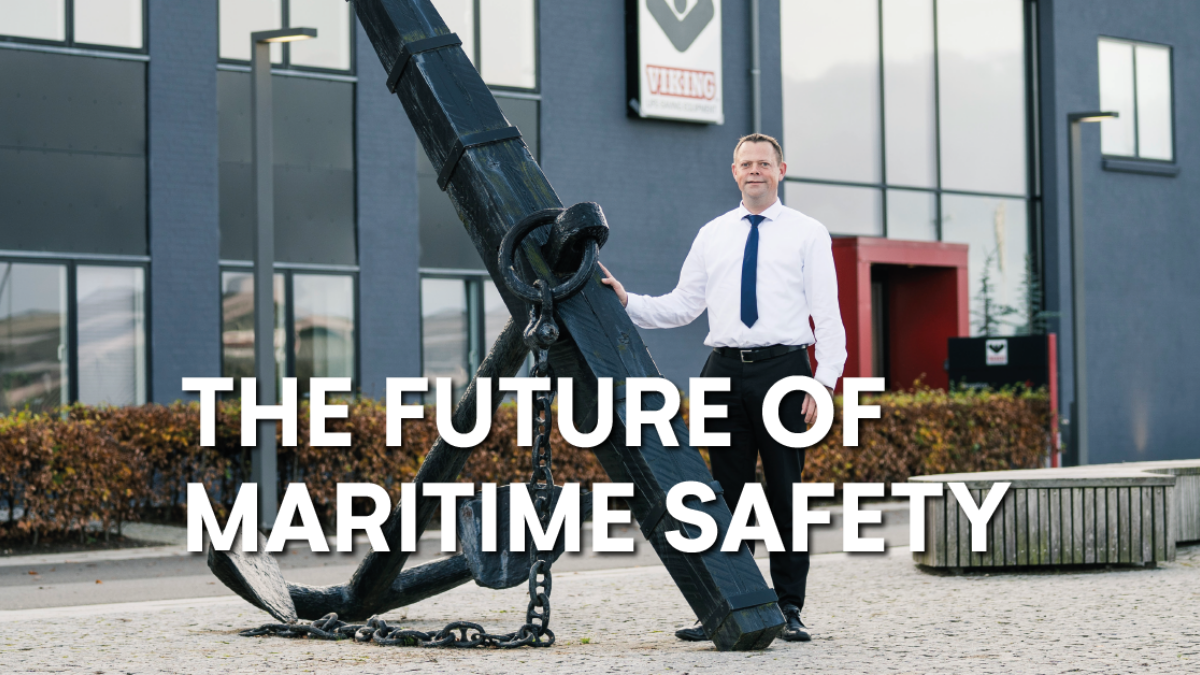
Safety standards are evolving to reflect the demands of the industry, which in turn is adapting to the demands of sustainability and technological advancement. We spoke to VIKING Life-Saving Equipment's Vice President Tim Engell Pedersen, to see how these elements are shaping one another and what that means for the future of marine safety.
For the shipping industry, safety standards and regulations are not just guidelines but lifelines. But as the industry grapples with building a new sustainable future it poses significant challenges for those at the sharp-end of the safety equipment sector.
Stringent standards and new regulations are juxtaposed against a sustainability imperative that demands change to the way products are manufactured, used and disposed. It is the proverbial rock and hard place.
Solutions rest in innovation and new ways of thinking. To get an insight on how that’s shaping the sector, we spoke to VIKING's Tim Engell Pedersen about the organisation's pioneering approach and how he sees it influencing the future of maritime safety equipment development.
Sustainability is arguably among the biggest concerns across industries at the moment. How do you balance that with safety standards for your equipment, because there will inevitably be some conflict?
TEP: We have very clear priorities within VIKING. When we are new designing or significantly redesigning our products going forward, the engineers, must develop a calculation to understand the impact of the product not only on the materials used but also transportation of parts servicing and end of life.
So, we are looking across the full life cycle for products and that analysis has to be established at very, very early stages even before we start creating our prototype. So it means considerations like whether we could reduce the amount of material being used in a lifeboat and have the same strength in the structure and potentially a larger rescue capacity relative to weight?
In that way, we factor in at very early stages when we are designing because that’s where you can make the biggest impact. So if you can think environmental care into the very early stages, you could say you get the benefit across the lifetime of the product and you end up having something which is easy to handle from a recycling perspective. But I fully understand your question. There will be cases where quality says one thing and environment says another, and because we are dealing with equipment designed to save people’s lives by performing when it matters, we cannot compromise on quality.
We obviously have the benefit of technology now too, which seems to find a solution for everything one way or another. How are you using data in this scenario?
TEP: We’re continuously working with data to systematically learn about our own equipment, how that functions and how that copes with the harsh environments. But also using it to detect if there are any other imminent risks that could impact the crew's ability to safely abandon the vessel or safely put out a fire or the like and rescue lives, for example.
Our Big Data and all that knowledge flows into our data cubes enabling
us to systematically learn where there are potential weaknesses, where there are other, evolving or previously unforeseen risks.
So for example, out of the data we identified that fires within containers were a problem, especially with the types of the product they’re now carrying and how the heat spreads. It led us to acquire a company called Hydro Pen. Their product is basically a light, portable device that is capable of drilling a hole into a container which then floods it with water until the container is filled. The crew can do that from a safe distance too. And that’s just one example. So in essence, we are now able to predict and see where risks are where we haven't been able to before, and find solutions too.
It’s fascinating because predictive data and safety equipment aren’t necessarily associated with each. It begs the question as to how you think AI will augment your approach further.
TEP: We're constantly building up the use of intelligent data to further foresee where these risks are, and we expect that AI will help us further to trace and detect patterns across our remit – whether that’s performance or gaps or defects or weaknesses or increased maintenance intervals for equipment.
So for example, if we draw on our technicians reports and detect that there are certain areas where there are potentially hidden risks that appear on a product – either our own or another brand – we use that to provide feedback, inputs and put forward suggestions for improvements, how equipment can be better maintained or used. It helps the crew to be safer and helps the industry to improve – and we see that AI will only help in that scenario. It can reveal opportunities for improvements that we cannot otherwise identify or that we might miss.
Finally, how does your personal philosophy on enhancing maritime safety influences Viking's approach?
TEP: I'm always keen to shift from the reactive approach to the proactive approach. And I don't want to finger point at the marine industry in either the regulatory parts of it, but it's always on my wish list to shift toward trying to foresee things before you have a major incident that we have to cope with retroactively. That's actually something we have on our agenda. How can we contribute to a more proactive approach seeing things before they arrive again with the ultimate goal of making safety at sea even better?