This article was featured in the official IMPA publication - Supply Chain and Sustainability Magazine, Issue 2 2024.
Detailing the essential guidelines and requirements for poison treatment chests on vessels under the 2022 IMDG Code, Huttons’ John MacDonald discusses the importance of preparedness for chemical accidents at sea, the challenges in sourcing medical oxygen, and the regulatory standards that ensure safety across different trading areas.
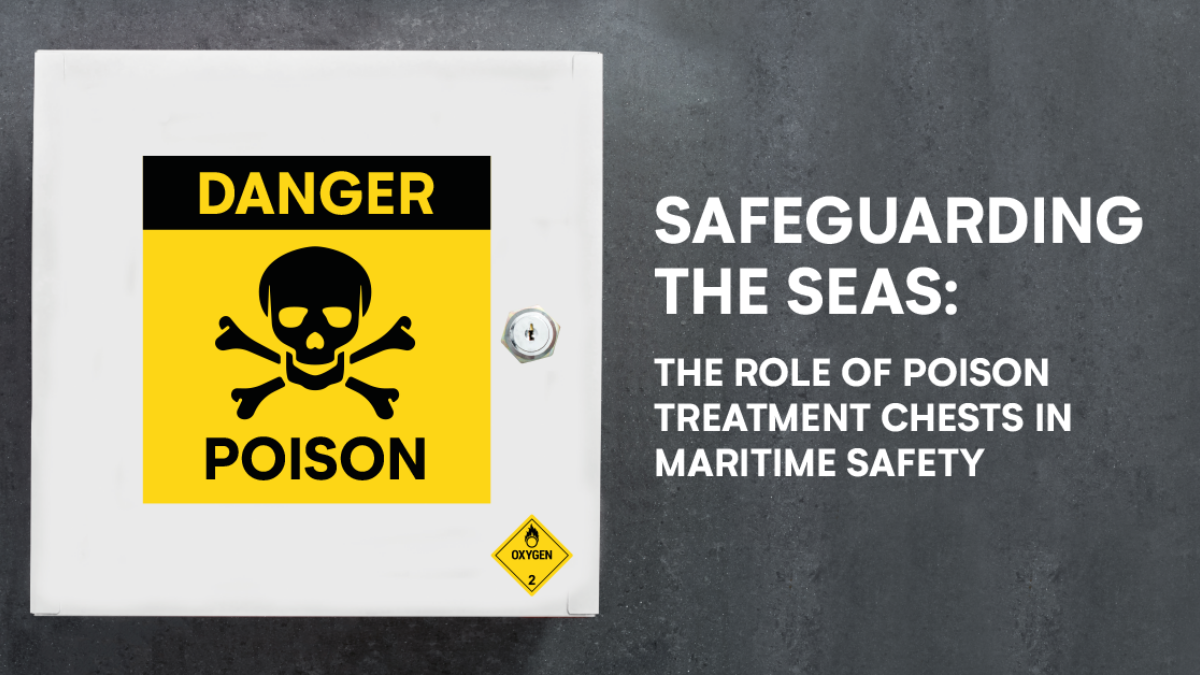
In addition to carrying a medical chest to treat crew involved in accidents or who fall ill, many vessels need to carry an extra medical kit -the IMDG/MFAG Code International Maritime Dangerous Goods Code 2022 Edition Supplement, otherwise known as a poison treatment chest.
This is required on vessels which carry certain dangerous cargoes as defined by the IMDG Code and is a list of medicines and equipment to be used in the event of an accident involving dangerous goods.
There are currently 25 medicines and 15 items of equipment which comprise the poison treatment chest. The quantities required are determined by trading area and voyage length. There are 3 classifications.
1. Area A: unlimited trading more than 24 hours from hospitalisation
2. Area B: coastal trading able to hospitalise within 24 hours
3. Area C: close to shore can be hospitalised within 2 hours
The current regulations are more concerned with supportive therapy, and getting casualties onto oxygen as soon as possible is the prime consideration. In this respect the IMO increased the minimum amount of oxygen to be carried to 44L. This is supplied as 40L in the sick bay to support two people at once and 4L in a portable resuscitator.
Anyone who has tried to get hold of medical oxygen since 2020 will be aware that it has been very difficult to obtain. During the pandemic there was none available in the private sector as all production was going to the NHS. Last year it was discovered that some companies were offering to refill medical oxygen cylinders for ships but they were not filling them with medical oxygen. There are ongoing police investigations as one manufacturer discovered some of their cylinders had been filled by a non-licensed company and did not contain medical oxygen.
Medical oxygen is a licensed medicine; it is manufactured only by UK Government licensed manufacturers and can only be sold by companies who hold a license called a WDA also issued by the UK Government.
In the UK all medical oxygen cylinders are painted solid white, (no other colour is allowed) and manufacturers will only fill white cylinders. If your cylinder was purchased in the UK and is any colour other than white you should have it checked.
It’s also worth noting that the colour of oxygen cylinders depends on the country and the standard used. In the US, oxygen cylinders are green according to the CGA Pamphlet C-9.
However, the colour of the cylinder body may not always indicate the gas inside, as different colours are used for the shoulder and top of the cylinder to denote different classes of gas. Therefore, it is important to check the label before using any gas cylinder.
Also, last year the largest supplier in the private sector was granted a five year manufacturing licence, so instead of the three year shelf life on medical oxygen we can now offer a five year shelf and 10 years on hydro test as we only use aluminium cylinders.
All vessels should have the complete IMDG code folders and the IMDG code Supplement. The supplement has lots of information regarding specific hazards but importantly contains the Medical First Aid Guide MFAG which lists the medical requirements and treatment regimens for many situations. These are set in a flow chart type system to guide you through the treatment.
Ferries and offshore support vessels carrying unknown commercial products will have to carry everything listed for its classification area. Exemptions can be granted by flag state authorities. For example ferries which have very short journeys 20 minutes or less will likely be exempted from having to carry a poison chest. Chemical tankers transporting only one product need only carry the items needed to treat an accident involving that cargo.
Some items in the Poison treatment chest are also carried in the crew medical locker. It is allowed to count these towards the quantity required in the poison treatment chest but most vessels keep the poison chest completely separate from the crew medical kit. These vessels carry the quantities required in both kits so they are not running around in an emergency taking items out of the crew medical kit to use in the poison treatment kit.