

This article was featured in the official IMPA publication - Supply Chain and Sustainability Magazine, Issue 6 2024
From environmental issues to safety regulations, the Scorpio approach is ‘What can we do that goes well beyond the minimum requirements? How can we lead the way, set the trends and help others to improve?’, says Paolo Magonio, Group Procurement Manager at Scorpio Ship Management. He spoke to Felicity Landon.
Which is better – paying $1 more for an item that lasts for five years, or paying $1 less for an item that needs replacing after only a year? Successful and effective procurement is not about purchasing on a day-to-day basis at the cheapest price – it’s about a vision of the total cost of management and the total cost of supply, says Paolo Magonio.
Scorpio Ship Management’s strategy is based on developing long-term supplier relationships to ensure on-time delivery of the right items at the right price and quality, but it also depends on detailed category management. “We cannot apply the same strategy to every category,” says Paolo. “Having the ability to dissect the whole procurement landscape and customise the supplier relationships, taking into account planning versus on-time purchasing, is key to delivering what is required. If a ship needs a product delivered, they don’t need to worry, we will get it to them. We have the structure, organisation, process and category management in place to make sure we can get that result.”
As the technical division of the Monaco-based Scorpio group of companies (Scorpio Group), Scorpio Ship Management looks after the maintenance and management of about 130 vessels, both Scorpio-owned (the majority) and third party. As Paolo says, anyone dealing with mainly a fleet of tankers is probably serving the most challenging part of the industry. “The ships we manage are moving worldwide from voyage to voyage with different types of cargoes. We are dealing with very short notice and a lot of uncertainty, usually without a clear visibility where these vessels will be. But that is what makes this part of the business very interesting! Time is often short, but we are structured to handle the challenges. We would be failing if we were not able to do so.”
Whether Scorpio-owned or third-party vessels, the mandate is the same – make sure the vessels are commercially viable and perform their voyages to the satisfaction of customers transparently and responsibly. Equally important, says Paolo, is a very high focus on safety and environmental protection, “going beyond the regulations”.
Scorpio has about 7,000 seafarers on its books and employs about 1,100 shore personnel in offices around the globe. The procurement team of about 30 is based in Monaco, Athens and Mumbai.
Paolo says shipping always likes to see itself as ‘different’, and it is, but for some of the fundamentals, maritime supply chain doesn’t differ much from the wider industry supply chain. “In that respect, the big trends are the need for innovation, digitalisation and automation, bringing in these to make the supply chain more efficient and effective in supporting your goals.”
He jokes: “For one ship, you are talking about thousands and thousands of items. Some people say the best strategy would be to have another ship in tow so that if anything breaks on the operating ship, you just take the bit you need off the towed one. That’s the example we use when we consider what consumables and spares should be carried. It would be easy to say let’s have one spare for everything for a year, but a ship has limited space and you would need a budget beyond reasonable to do this anyway. Obviously, digitalisation and any sort of innovation to collect, process and turn data into strategic drivers is essential.”
Maritime can be slow to embrace and adopt new technologies, he says, and a successful supply chain depends on every link in the chain. “So, in order to deliver our aspirations, we must engage with others and have proper conversations depending on the category and type of items.”
He draws a parallel with the IMPA SAVE initiative to eliminate plastic water bottles and introduce an onboard water filtration system. Paolo, a member of the IMPA Council, is proud to note that all plastic bottles have been removed from Scorpio vessels, with 95% of drinking water supplied by the onboard filter and a 5% stock of carton water, initially a challenge to source.
"Today there is a worldwide maritime availability of water in cartons, thanks to the IMPA initiative. It was all about collaboration, working together to find a way – and we couldn’t have done that by ourselves. Now we are looking at the recycling of mooring ropes, talking to potential suppliers, rope manufacturers, waste disposal companies and other partners in ports, to find a solution and promote the concept to others to generate the critical mass.”
Across maritime procurement, Paolo believes the industry has been reluctant to get advice and expertise from outside. “The usual argument is that ‘we are serving moving targets’, but so is the aviation industry and the transport industry. There is no reason why there should not be more osmosis of ideas with other industries.”
The Scorpio Group is involved in a series of environmental and sustainability initiatives. “Our commitment extends beyond profit, and we want to leave a positive impact,” he says.
The first ships built for Scorpio were double-hulled, 27 years before they were ruled mandatory for environmental safety for vessels built from 1993. Today, the group operates a modern fleet of ‘eco vessels’, considered among the most efficient tanker fleets in terms of environment, fuel consumption and emissions. The vessels feature optimised hydrodynamic hulls, electronic long-stroke main engines and low-friction coatings, enhanced cargo tank coatings, a bulbous bow, enlarged propellers and Mewis Ducts, all to maximise performance and operational efficiency. Scorpio has also invested in smart sensors and big data analytics to identify any inefficiencies and implement optimised solutions.
In February 2024, Scorpio attracted headlines when it announced it was installing Fuel Oil Water Emission (FOWE) systems across all vessels. FOWE creates an emulsified fuel which increases engine efficiency, by means of reducing fuel consumption and Green House Gas emissions; Scorpio is expecting a reduction of 3% in fuel costs and the elimination of 100,000 tonnes of carbon emissions annually.
The group has been involved in initiatives such as the Protecting Blue Whales and Blue Skies Vessel Speed Reduction (VSR) programme to protect the lives of endangered whales and lower pollution levels while sailing off the California coast.
The elimination of single-use plastics and reduction of packaging are key to the procurement process. “We focus on buying in bulk with less packaging where possible. We also drive our vendors to collect and provide their data on emissions and this will influence how we will purchase in the future.” This is the idea behind IMEF, the new initiative from IMPA SAVE initiated by Scorpio and other members, with the goal of bringing the maritime supply chain up to speed in collecting and analysing product emission data.
Originally from Genoa, Paolo comes from a maritime family: his father worked for shipping companies and his grandfather was a shipyard worker. Paolo started his career working for a ship supply company, moving on to ship management of merchant and cruise vessels, where he took on a purchasing role. After relocating to the United States to work for a cruise company for a couple of years, he moved to Monaco, where he worked for a cruise company and a ship manager before joining Scorpio in 2019.
“Having worked for small companies and large corporations on both the ship and supplier side, I would say the thing I have learned is to always understand the other person’s perspective,” he says. “Try to have a different perspective from your own in each and every aspect of business. It helps from both the strategic and procurement point of view if both sides understand what the other is trying to achieve. Developing partnerships and collaborating with others is so important.”
Among the highlights of his career, he mentions the day that Scorpio completed the entire fleet supply with carton water – “we could actually say our fleet was plastic free”. In another area completely, he recalls earlier in his career spending two days and nights in the office organising the urgent charter of an Antonov aircraft which took off from the Czech Republic, landed in Belgium, loaded a 12-metre shaft and transported the essential component to Helsinki where a cruise ship – with passengers on board – was stuck in port. “This is still a special memory for me because of the time and effort required and the satisfaction of being able to resolve a big setback for the company I was working for at the time.”
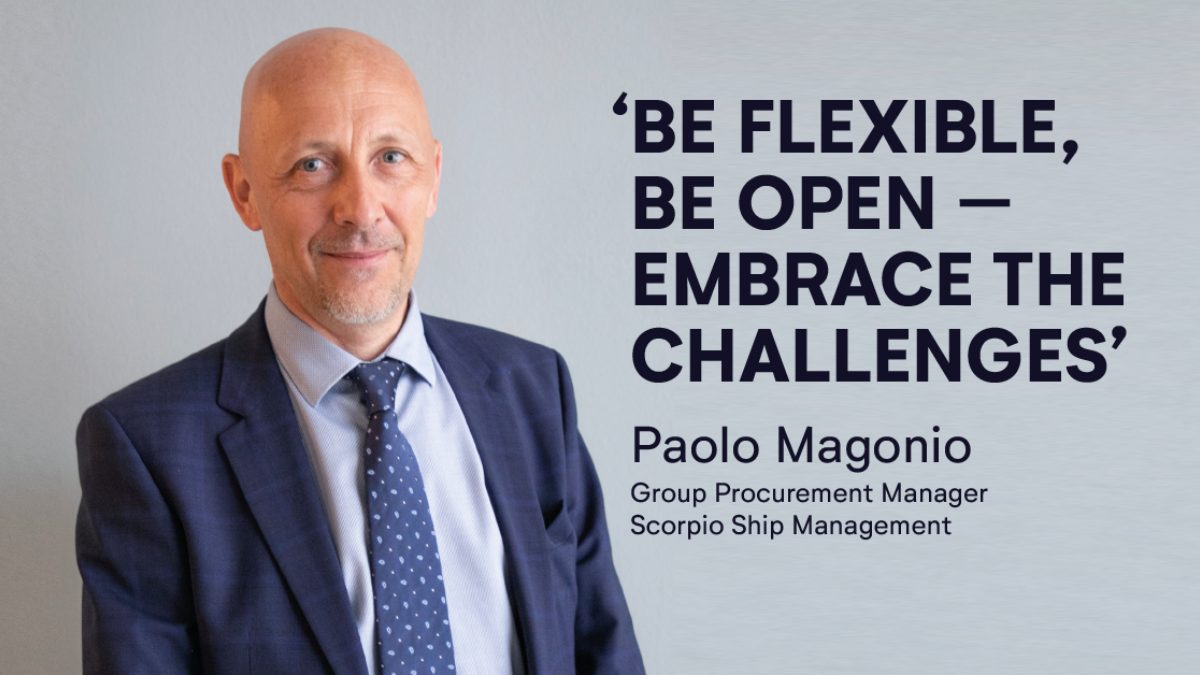
For those starting out in the procurement industry, Paolo says that there is often ‘LinkedIn humour’ around a day in procurement – how difficult it is, how procurement people can be the last to know something. “I would reverse that completely and say, ‘You are lucky – it’s an exciting career full of opportunities to connect with people from all around the world and from different cultures.’ Whether you are looking after the day-to-day logistics of delivering a consignment from one corner of the world to another or in a position to negotiate contracts and supply agreements, it is never boring and always challenging to find different ways of resolving problems. It is all about being flexible, open, and able to see other people’s perspective. Be curious, be interested in what you are doing, and the satisfaction will come!”

