This article was featured in the official IMPA publication - Supply Chain and Sustainability Magazine, Issue 1 2024
In this regular column, we reach out to IMPA SAVErs to see why they joined IMPA’s most ambitious sustainability initiative to date, how they are faring and why they think others should join.
Back in 2020, IMPA SAVE was created to bring together members from the industry to support sustainability initiatives, embrace and transition to new greener solutions and to take climate action now. The first goal of the programme? Encouraging ship-owners, ship-managers and maritime suppliers around the world to choose suitable planet-friendlier alternatives to the vast quantities of plastic bottles that are currently delivered to the global fleet. Close to three years onwards, more than 100 companies in our industry have pledged to change the status quo.
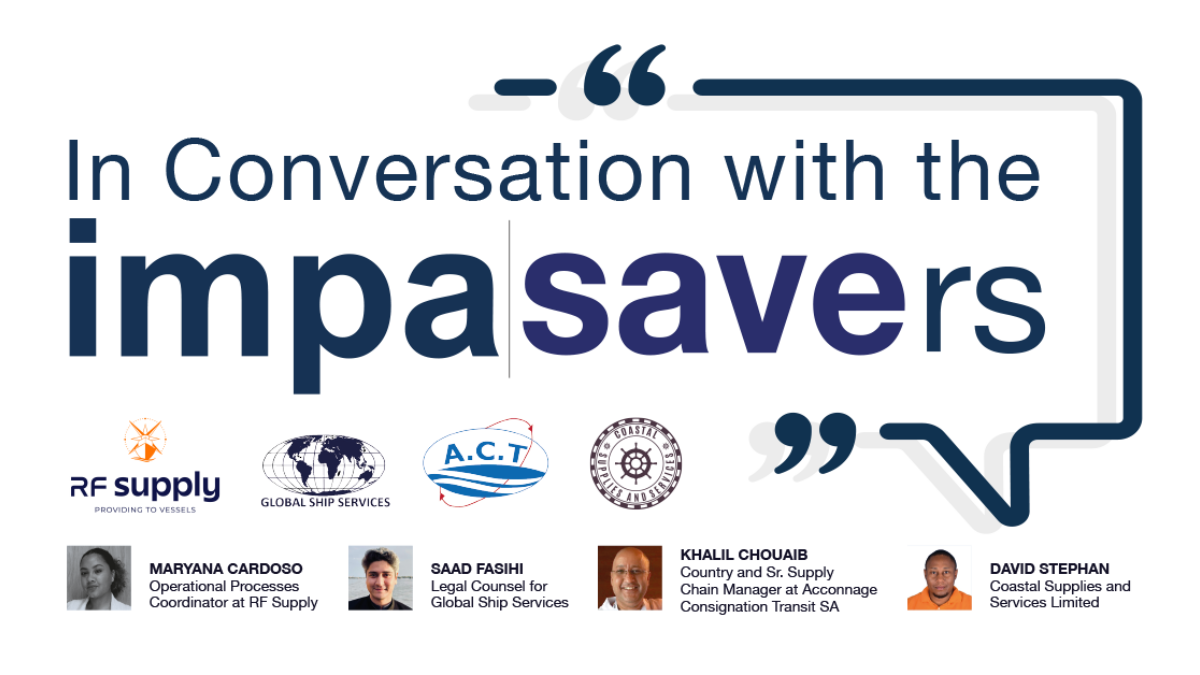
Today, our team is joined for an interview by four recent IMPA SAVE pledgers: Maryana Cardoso, Operational Processes Coordinator at RF Supply in Brazil, Saad Fasihi, Legal Counsel for Global Ship Services in United States, Khalil Chouaib, Country and Sr. Supply Chain Manager at Acconnage Consignation Transit SA in Mauritania, and David Stephan at Coastal Supplies and Services Limited in Tanzania.
How did you come across the IMPA SAVE initiative and why have you joined?
Maryana Cardoso [MC]: We got to know IMPA SAVE through IMPA's presentation on the organisation's sustainability measures, as well as through conversations with partners who reinforced our curiosity about the initiative. Given the need for actions with an immediate sustainable impact and the notion of our responsibility as a company to contribute to effective sustainability measures, joining IMPA SAVE and collaborating directly with efforts to clean the oceans was an important step of social awareness.
Saad Fasihi [SF]: Global Ship Services (GSS) actively participates in the industry's environmental initiatives. Our Chairman, Mr. Salim, and our Director International Operations, Mr. Waleed, engaged in extensive discussions with Mr. Mikael Karlsson, Chair of IMPA Save, during the IMPA London 2023 event. We at GSS believe that marine plastic pollution is a pressing concern with at least 14 million tons of plastic ends up in the ocean every year, and plastic makes up 80% of all marine debris found from surface waters to deep-sea sediments. At GSS, sustainability is a fundamental value, and our commitment to embracing sustainable practices within the maritime industry led us to the IMPA SAVE initiative. To achieve this aspiration, we must collaborate with those who align with our principles.
Khalil Chouaib [KC]: I found out about IMPA SAVE through IMPA literature. And I immediately thought that it was necessary that all stakeholders in the supply chain get involved with this initiative. I have decided to join, as our headquarters is located in Nouakchott, West Africa, and according to global warming reports, the city is among the first exposed to the dangers of the global warming, being many meters below sea level, and with no sewage infrastructure, besides being protected from the Atlantic Ocean waves only be a thin sand layer, I see the disaster can happen at any moment when the sea weather becomes rough enough.
Mauritania is also a large fish exporting country, and have agreements with the EU, Japan, and China for fishing, and we have also a sister company, ACT FSL, exporting fish, and would like to develop this trade lane further, fishing being one of the most important Mauritanian economic sectors providing hard currencies, and preserving this natural renewable source has certainly something to do with the IMPA SAVE.
David Stephan [DS]: I learned more about IMPA SAVE when I attended the IMPA Annual General Meeting in London in 2023, but I had heard about the programme earlier last year through email campaigns sent by IMPA’s Membership Manager, Stevie. Having seen the effect of single-use plastic and plastic bottles in my country and globally, notably when it comes to marine and aquatic life, I pledged to participate in the initiative and contribute my efforts towards eradicating or minimising the
use of plastic.
How have you undertaken or are planning to undertake the journey towards eliminating plastic drinking water bottles onboard the global fleet?
MC: There was significant progress, mainly because we reinvented our logistics process by adopting the practice of reusable water gallons with our long-stay customers, and eco-friendly packaging on some other items. We are currently in negotiations with a Brazilian company specialising in packaging made from plants, such as lids and tops of water boxes made from sugar cane, and while we have not yet completed the exchange of supplies, we continue to search for effective alternatives considering the obstacles regions we face.
SF: We annually supply approximately 300,000 litres of water bottles to vessels, actively working to eliminate single-use plastic water bottles from our global fleet. Our strategy involves collaborating with suppliers to explore eco-friendly alternatives, notably promoting Tetrapak water bottle cases. We have achieved significant progress, with up to a 30% shift towards supplying Tetrapak water bottle cases to both the crew and vessels. Additionally, we are proud to announce our acquisition of the ISO 26000 certification, affirming our status as a socially responsible organization. Our commitment to transparency and creating a greener future for generations to come remains steadfast.
KC: We have started, as a ship suppliers, providing recycled bottles, and alternative packaging, instead of plastic, and our clients portfolio, especial in the oil and gas industry seem to like the alternative when we present it in offers, and this encourage us to keep going, as business revenues are not affected, and the environment protection, and moral duties are fulfilled.
When it comes to sustainability, what is most important to you, as well as your company?
MC: We believe that sustainable practices should be integrated as a habit and not just as a requirement. We are one of the few maritime companies in our region to take on a sustainable initiative, and we always seek to implement strategies and add to our mission.
We currently use strategies with effective results. We work in a hybrid home office model, to reduce energy impact and transport subsidies, partnership with recycling organisations, and alternatives used in the operational logistics of deliveries, such as bags that are reusable, returnable baskets, reduced use of plastics, eco-friendly packaging, and soon awareness initiatives for partner companies.
SF: Sustainability is paramount for both me and our company. Our focus lies in fostering eco-friendly practices throughout our operations around the globe, reducing environmental impact, and promoting a circular economy. Prioritising sustainable sourcing, waste reduction, and community engagement are key aspects that align with our commitment to a greener future.
KC: Sustainability is at the core of our maritime supply operations. Our ESG efforts are robust, featuring a shift away from single-use plastic through initiatives like Tetrapak water bottle cases and utilising reusable and durable packaging materials for provisions, such as bio-degradable wood pallet boxes and containers to minimise single-use plastic waste. We promote reusable solutions, collaborate with eco-conscious suppliers, and invest in energy-efficient technologies. Our commitment to a greener maritime industry extends to ongoing evaluations of our supply chain for continuous environmental advancements.
What is important to us is, in fact, mentioned in the IMPA SAVE logo itself, to which I agree completely: people, planet, profit, purpose.
What would you tell others who are thinking of getting involved with IMPA SAVE?
MC: It is important to take a stance on the negative results caused by unsustainable practices adopted over the years. But more than that, joint efforts lead to good results and, although sustainability may seem like high costs, it is not possible to ignore the importance of the topic in today's corporate world and proof of adherence to these practices is increasingly seen as a condition essential for any business.
SF: Choosing sustainability is not just a decision; it is a strategic advantage. We encourage others to swiftly join our efforts because acting promptly is crucial for meaningful results. By collaborating, organizations not only benefit from sustainable innovations and technologies but also witness positive growth in human performance. Sustainability equals improvement. Moreover, the risk of becoming obsolete looms for those who don't adapt. There's no one-size-fits-all solution; diverse initiatives are key. Companies embracing cooperation, diversity, and engaging with industry leaders like GSS will successfully diversify their sustainability perspective, achieving both individual and industry-wide goals.
KC: Participating in initiatives like IMPA SAVE is an essential step for any organisation in the maritime industry that values sustainability and environmental responsibility. By collaborating with companies that share the same vision, we can collectively drive positive change and work towards a greener future for the industry.
DS: Get involved with IMPA SAVE. It may be a difficult task to kick plastic, but it is important to start now with raising awareness of the problem, advocacy, lobbying authorities on change and educating others on the issue with plastic.