

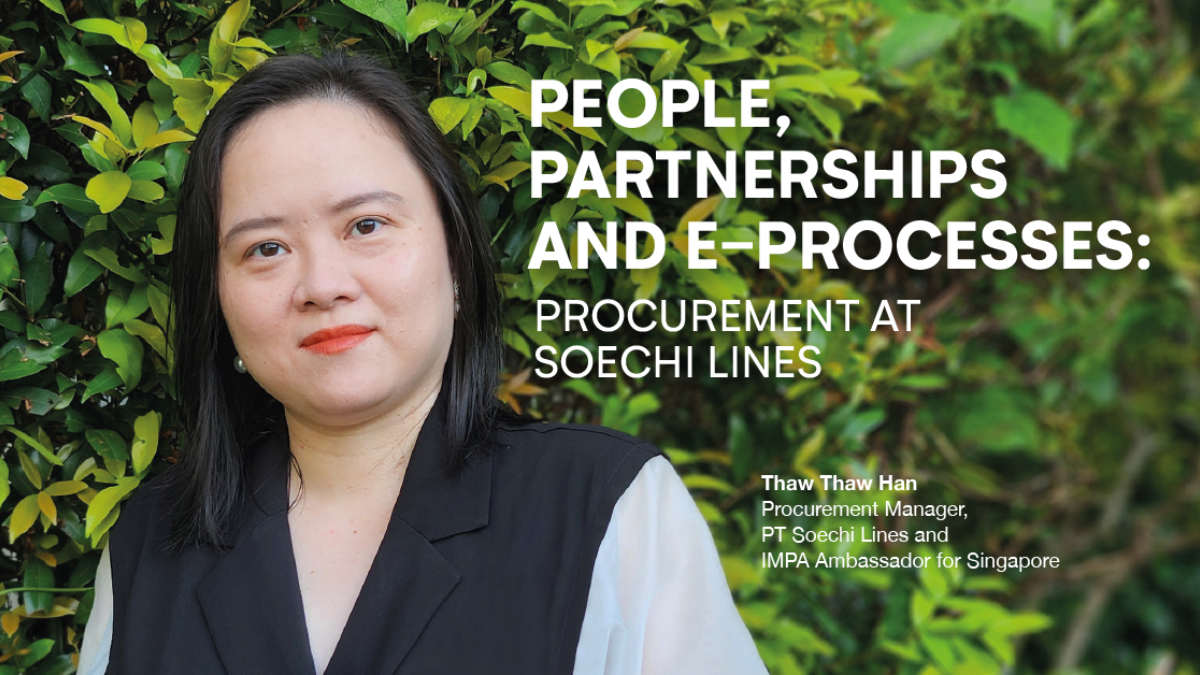
Effective supply chain management is all about people and partnerships, says Thaw Thaw Han, Procurement Manager at PT Soechi Lines and IMPA Ambassador for Singapore – but it’s also about embracing advanced digital tools and AI technology. She spoke to Felicity Landon.
Cost optimisation is a key strategic goal for any supply chain management professional, but Thaw Thaw Han is adamant that cost optimisation can only be achieved through working together to deliver the best solutions for both sides.
As Procurement Manager for Soechi Lines, one of the largest tanker operators in Indonesia, Thaw Thaw is supporting more than 50 vessels ranging from 1,500 to 308,000 DWT. The fleet provides domestic services in Indonesia and operates internationally in a network covering South-East Asia, India and the Middle East, transporting oil, gas and chemicals. She says there are many steps that can be taken to optimise cost. A particular focus is standardisation across the fleet, so orders are consolidated and discounted prices are possible.
“This approach also gives the supplier an opportunity to make cost savings, and that is important,” she says. “In order to get our own savings, we also need to help the supplier to offer a good price. Working should be a two-way communication. You must talk with your suppliers and have the right mindset and strategy as to how you will cooperate to generate solutions that all are happy with – otherwise you will not have a long-term partnership.”
Based in Soechi Lines’ Singapore branch office, Thaw Thaw works with a procurement team of ten people based in the Jakarta head office. Originally from Myanmar, she started her career in freight forwarding and offshore. “I relocated to Singapore in 2007, where I deepened my understanding of the international marine industry and gained comprehensive technical knowledge of ship equipment, machinery parts and consumables, as well as the intricacies of the procurement cycle,” she says.
“Over the past 17 years, I have significantly expanded my international vendor network from hundreds to several thousands of relationships. This growth has equipped me with valuable insights and experience in addressing the challenges faced in ship owner and ship management supply chain management.”
She describes her role as ‘all about people’, adding: “My job gives me the opportunity to meet people from different countries and cultures, and to learn about different business styles and approaches.”
When Thaw Thaw describes her key strategic goals in supply chain management, what’s clear is that the same partnership approach applies to each of them.
For example, supplier relationship management and supplier vetting and risk management: potential suppliers are screened for sanctions compliance, business licence, ISO certification, class approval certificates, engineering competency, sustainability, their vision and mission financial statements, and whether they are qualified to be long-term vendors.
“Having said that, if we decide against taking on a particular company as a top supplier, we go back and review it all every two years to update our information. It is very important to revisit and reassess in this way,” she says.
Sustainability is another strategic goal. Soechi Lines focuses on consolidation to key destination ports to be sure of keeping the carbon footprint as low as possible. “We must raise awareness of sustainability and encourage suppliers as a ‘good citizen’ issue – that doesn’t mean forcing them to do everything but it means starting from small initiatives, such as using an electric delivery vehicle or reducing plastic packaging. At Soechi Lines, we implement a robust Good Corporate Governance (GCG) programme based on the principles of transparency, accountability, responsibility, independence and fairness. As a responsible corporate citizen, we are committed to quality, health, safety, security and environmental preservation.”
Agility and flexibility, and continuous improvement are also key goals. Thaw Thaw says: “Flexibility isn’t only about the vendor – we must also have flexibility. Before we place an order, we are always thinking and checking and understanding the other side: what would be the best solution for us both, and how do we reduce the risk of incurring unexpected additional costs?
“When it comes to continuous improvement, I get feedback from all departments. I never listen only to
one side of the story – I listen to both sides and always try to get in contact with whoever is involved in the case, to get their suggestions for doing things better.”
Finally, she highlights technology and systems utilisation. “We are seeing significant changes. More and more people are coming on board for the utilisation of technology and digitalisation. We are seeking to align and rationalise systems to have a single source of data and report to management what data-driven decisions we make. I think technology is going to be key,” she says.
“In ship owner and manager environments, my goal is to implement advanced digital tools and platforms that enhance visibility across the supply chain, enabling data-driven decision-making. Additionally, I aim to develop a comprehensive vendor management system that includes product and service catalogues, allowing for automated inquiries to the right vendors through AI technology.”
She predicts that in five years’ time, many day-to-day processes will be covered by AI technology – for example, e-procurement and batch update inventory systems. “AI will enable more visibility and more transparency, which is particularly relevant for achieving accurate inventory management and stock control on board – always a difficult area.”
Thaw Thaw says supply chain disruptions, continuous mergers, acquisitions and expansions, the focus on sustainability and the ongoing digital transformation are all significant issues to be handled at present. For the future, prioritising supply chain resilience, increasing automation and emphasising data-driven decision-making will be key.
She is passionate about her role as IMPA Ambassador for Singapore, which she took up in 2008 – 16 years after she first learned about IMPA when she started working in Singapore. She is keen to promote IMPA to suppliers and create more awareness across the region. “We must bear in mind that the junior purchasing managers in Asia today will be the generation leading their companies one day. We should continue to build IMPA’s influence in Asia for the future. I also want to show that women can work in this industry and that woman can come on board to contribute to society,” she says.
Thaw Thaw joined Soechi Lines in April 2024, having previously worked as Group Procurement Manager at Thome Group. What is her advice to new procurement staff or those considering a career in procurement? “Build a strong foundation, both technical and commercial. Establishing good communication with suppliers and internal stakeholders is essential for successful collaboration. Additionally, leverage procurement systems and tools to enhance efficiency and continuously seek opportunities for learning and development. Finally, do not hesitate to ask for guidance from more experienced colleagues or seek mentorship to support your growth in the field!”
Unlock this article
This article is for IMPA Members only, please login or consider becoming a member .

